Here is what you need to know for the first class on Wednesday, January 7.
Class Meetings: Due to work-related travel, we will not hold class on the following days. We will discuss during the first class about how we will handle make-ups. My apologies in advance for the inconvenience; this is all FIU-related and unavoidable.
• Thursday, January 8-Friday, January 9
• Thursday, February 5-Friday, February 6
• Friday, February 13 (tentative)
• Thursday, March 19-Friday, March 20
Required Materials: You must have print versions for all materials. You can get the pleading packets from the boxes outside my office.
1) Linda S. Mullenix, Leading Cases In Civil Procedure (West 4th ed. 2022)
2) Joseph Glannon, The Glannon Guide to Civil Procedure (Wolters-Kluwer 5th ed. 2023)
3) Federal Rules Of Civil Procedure (2025 ed.) (Compiled by Kevin M. Clermont) (Yes, you must use the most recent version of the rules)
4) Pleadings (available outside my office; pick up prior to first class)
5) Civil Procedure Blog: http://fiucivpro.blogspot.com (indicated in syllabus), especially Supplemental Materials post.
Technology and Class Conduct
Use of laptops, tablets, smart phones, and similar devices during class is prohibited, unless granted permission. Phones must be turned off when you come into the classroom.
Plagiarism Policy
Do not.
AI Policy
Do not.
The use of ChatGPT and other generative AI or LLM programs for written assignments is prohibited.
Locating Assignments:
We work materials from different sources and places. This is unavoidable. Please bring all assigned materials to class on the appropriate day.
Unless otherwise indicated, assigned cases are in Leading Cases in Civil Procedure (Leading Cases) commentary, detail, elaboration, explanation, and examples are in Glannon’s Guide (“Glannon”). Rules, Statutes (from Title 28 of the United States Code), constitutional provisions, and legislative history can be found in Federal Rules of Civil Procedure, unless indicated otherwise:
• Part 2: Federal Rules of Civil Procedure (without committee notes)
• Part 3: Advisory Committee Notes from past amendments to FRCP
• Part 5: Selected provisions of the U.S. Constitution and procedural statutes from 28 U.S.C.
• Part 7: Sample Local Rules of Civil Procedure
Additional assigned cases, articles, statutes, rules, and other materials should be downloaded from the Supplemental Materials post.
Book and page numbers are in parentheses after each assigned case in Leading Cases. Provisions are found in the relevant Part of the FRCP book. Items found in the Supplemental Materials are indicated as Blog.
Sample Pleadings are in the bound supplement, available outside my office.
You must have your FRCP pamphlet with you and open on your desk in every class. You must have any assigned statutes, provisions, cases, or documents with you and open on your desk in every class.
Assignments for the first class (Wednesday, January 7) after the jump.
Introduction to Civil Procedure:
Provisions:
U.S. Const. art. III
U.S. Const. amend. V, VII, XIV
Fed. R. Civ. P. 1, 58, 60, 83
28 U.S.C. §§ 1331-1332
28 U.S.C. § 1257
28 U.S.C. §§ 1291, 1254
28 U.S.C. §§ 2071-2074
Case Excerpt:
Shady Grove Orthopedic v Allstate Ins. Co. (Leading Cases, Part II.B, first 2 ¶s, pp, 683-84)
Sample
Pleadings: (Review and begin to familiarize)
Naruto v. Slater (Complaint) (Pleadings)
Godin v. School Union # 134 (Pleadings)
Morgan v. Wal-Mart (Pleadings)
Visions of America v. Boston Symphony Orchestra (Pleadings)
Other Materials:
Courts of Florida (Map)
Courts of Florida (Chart)
Barton, Great Judicial Stylists (Skim)
2025 Year-End Report on the Federal Judiciary (Appendix workload statistics, pp. 10-15)
Be ready to discuss the following:
• What is "procedure" or "procedural law" as opposed to "substance" or "substantive law?" What is the substantive law involved in the four sample pleadings (Naruto, Godin, Morgan, and Visions)?
• Parse the definitions of procedure in Shady Grove.
• If you are creating a set of procedural rules for a judicial system, what values or principles or policies do you want those rules to serve and further? How do different values or policies complement or conflict within a system of procedural rules? What is the goal of having a system of procedural rules?
• What are the possible sources of procedural rules for courts?
• The 5th and 14th Amendments guarantee "due process of law" before loss of life, liberty, or property. What should "due process" entail or guarantee?
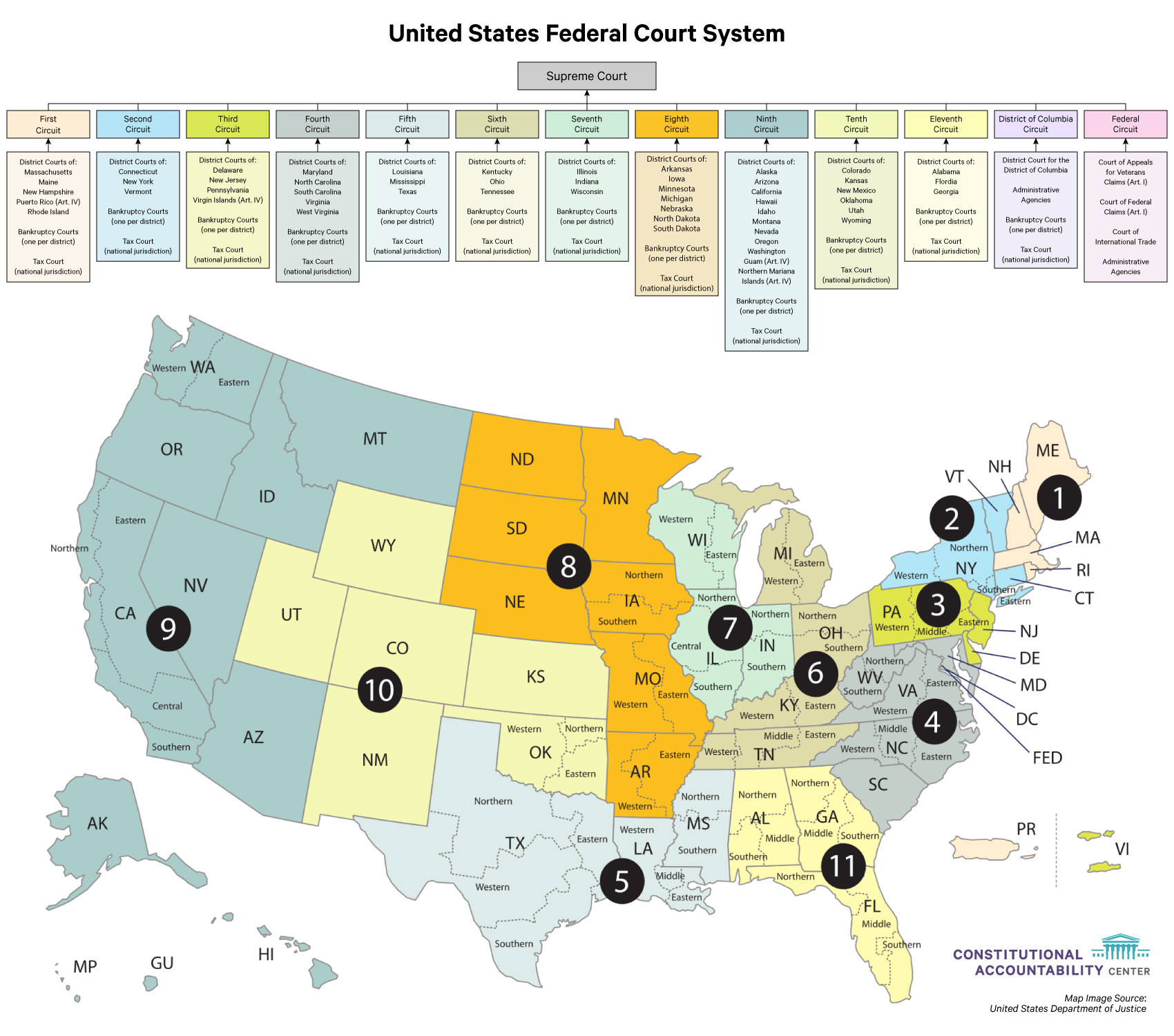
• Review the materials showing the structure of the federal and Florida judicial systems.
• Carefully read §§ 2071-2074 (the "Rules Enabling Act"). What is the process for creating the Federal Rules of Civil Procedure? What is the role for SCOTUS and what is the role for Congress?
• The United States operates as an "adversary system"--what does that mean? What is the theory beyond that?
• What does "jurisdiction" mean? Consider the distinction between two pairs: "Original" v. "Appellate" jurisdiction and "Concurrent" v. "Exclusive" jurisdiction. What is the consequence of appellate review being limited to "final" orders?